
Lessons from the Mondrian Gold Coast
How engineering, coating selection and glazing design helped deliver one of Australia's most distinctive curved glass façades.
 Architect: Fraser & Partners
Builder: Hutchinson Builders
Introduction
The growing use of curved glass in hospitality, commercial and mixed-use developments has created new opportunities for architects to deliver distinctive building forms.
However, achieving a successful curved glass façade requires more than simply producing glass to a nominated radius.
When coatings, colour, reflection and geometry all interact together, maintaining architectural intent becomes one of the most significant challenges in façade delivery.
The recently completed Mondrian Gold Coast provides an excellent example of how these challenges can be successfully managed through early engineering coordination and careful glazing design.
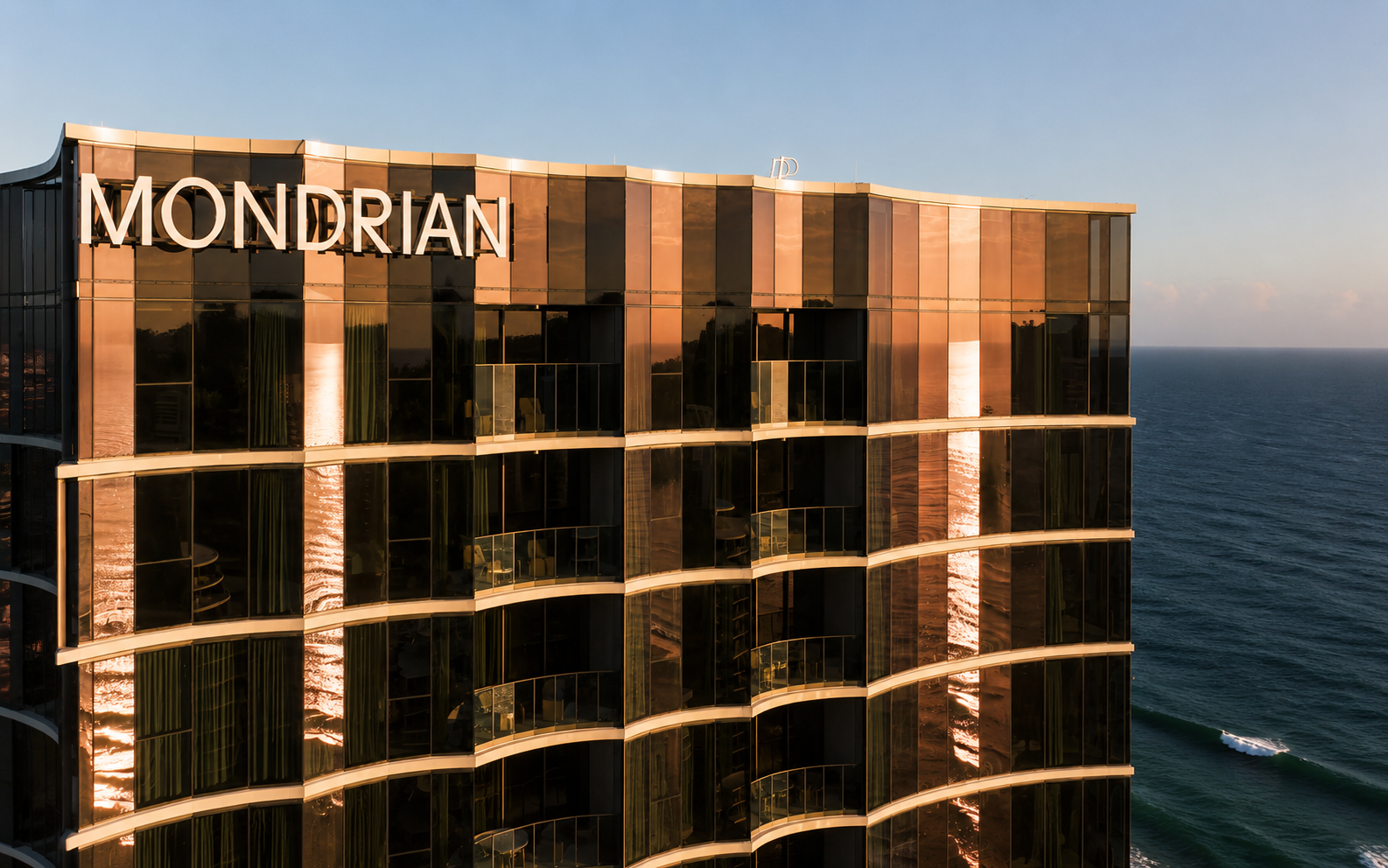
Located on the Burleigh Heads beachfront, Mondrian Gold Coast combines luxury hotel accommodation, premium residences and public hospitality spaces within a highly sculpted architectural form designed by Fraser & Partners and delivered by Hutchinson Builders.
ASG supplied the glazing package incorporating both flat and curved glazing elements utilising Champagne 40-1 low-e glass combined with Grey Bronze glass.
The Challenge of Curved Glass
Architects often expect curved glass to appear identical to adjacent flat glass.
In practice, this is rarely the case.
The process of bending glass introduces subtle optical characteristics that influence how a façade is perceived.
These effects become even more noticeable when coated glass products are used.
Factors that influence final appearance include:
• Curved versus flat geometry
• Convex and concave panel orientation
• Coating placement
• Reflection characteristics
• Viewing angle
• Environmental lighting conditions
When curved and flat panels are positioned immediately adjacent to one another, even minor visual differences can become apparent.
Managing these interactions is often one of the most important façade engineering considerations on premium developments.

Balancing Performance and Appearance
The Mondrian façade utilised Champagne 40-1 low-e glass paired with Grey Bronze glass to achieve both performance and aesthetic objectives.
The selected glazing solution provides:
• Strong solar control performance
• Reduced solar heat gain
• Refined external reflectivity
• A sophisticated colour palette suited to the beachfront environment
For luxury hospitality developments, appearance often becomes just as important as thermal performance.
A technically compliant façade can still fall short if colour consistency and visual quality expectations are not achieved.
Managing Curved and Flat Glass Together
One of the primary engineering considerations on Mondrian was ensuring consistency between curved and flat glazing elements.
Curved glass naturally reflects and refracts light differently from flat glass.
Reflections stretch and compress across curved surfaces, changing how colours and coatings are perceived from different viewing positions.
Concave and convex panels can also produce different visual effects despite utilising identical glass constructions.
ASG's role involved assessing these variables early to ensure the façade worked as a complete architectural composition rather than a collection of individual glass panels.
The objective was not to eliminate all variation, which is often impossible, but to ensure that any variation remained consistent with the architect's design intent.

The Importance of Early Sample Review
For complex façades, appearance risk is best managed before fabrication begins.
Sample review allows project teams to evaluate how coatings, substrates and curved geometries interact under real-world conditions.
This process assists in identifying potential concerns relating to:
• Colour perception
• Reflection behaviour
• Coating appearance
• Visual consistency
• Distortion expectations
Resolving these issues during design development significantly reduces risk later in the programme.
Delivering the Mondrian Vision
Delivering a façade of this complexity required close collaboration between Fraser & Partners, Hutchinson Builders, the façade contractor and ASG throughout the design and procurement process.
Careful consideration of curvature, coating selection, colour consistency and visual performance helped ensure the completed façade achieved both the architectural intent and performance expectations of a premium beachfront development.
Today, Mondrian Gold Coast stands as one of Australia's most distinctive hospitality projects, demonstrating how advanced glazing solutions can transform ambitious architectural concepts into built reality.
Projects such as Mondrian highlight that successful curved façades require more than manufacturing capability.
They require engineering expertise, early coordination and a thorough understanding of how glass will ultimately be experienced once installed on the building.

Related Article
Managing Distortion and Tolerances on Complex Façades – UNSW Health Translation Hub
Explore More Projects
Share:
Newcastle Airport Expansion: Delivering High-Performance Glazing for Australia's Newest International Gateway
Castle Residences Sydney When Glass Shapes Architectural Character