
Risk or Problem
Heat-treated glass is widely used to improve structural strength and thermal performance in façade applications. However, the tempering process can also introduce several technical challenges that may affect both safety and visual quality.
Roller wave distortion and anisotropy may become highly visible under reflected light, particularly on large façade panels. In addition, residual inclusions within the glass can increase the risk of spontaneous breakage if not properly controlled.
How ASG Helps Reduce Risk
To minimise these risks, ASG implements multiple inspection and verification procedures throughout the heat-treatment process.
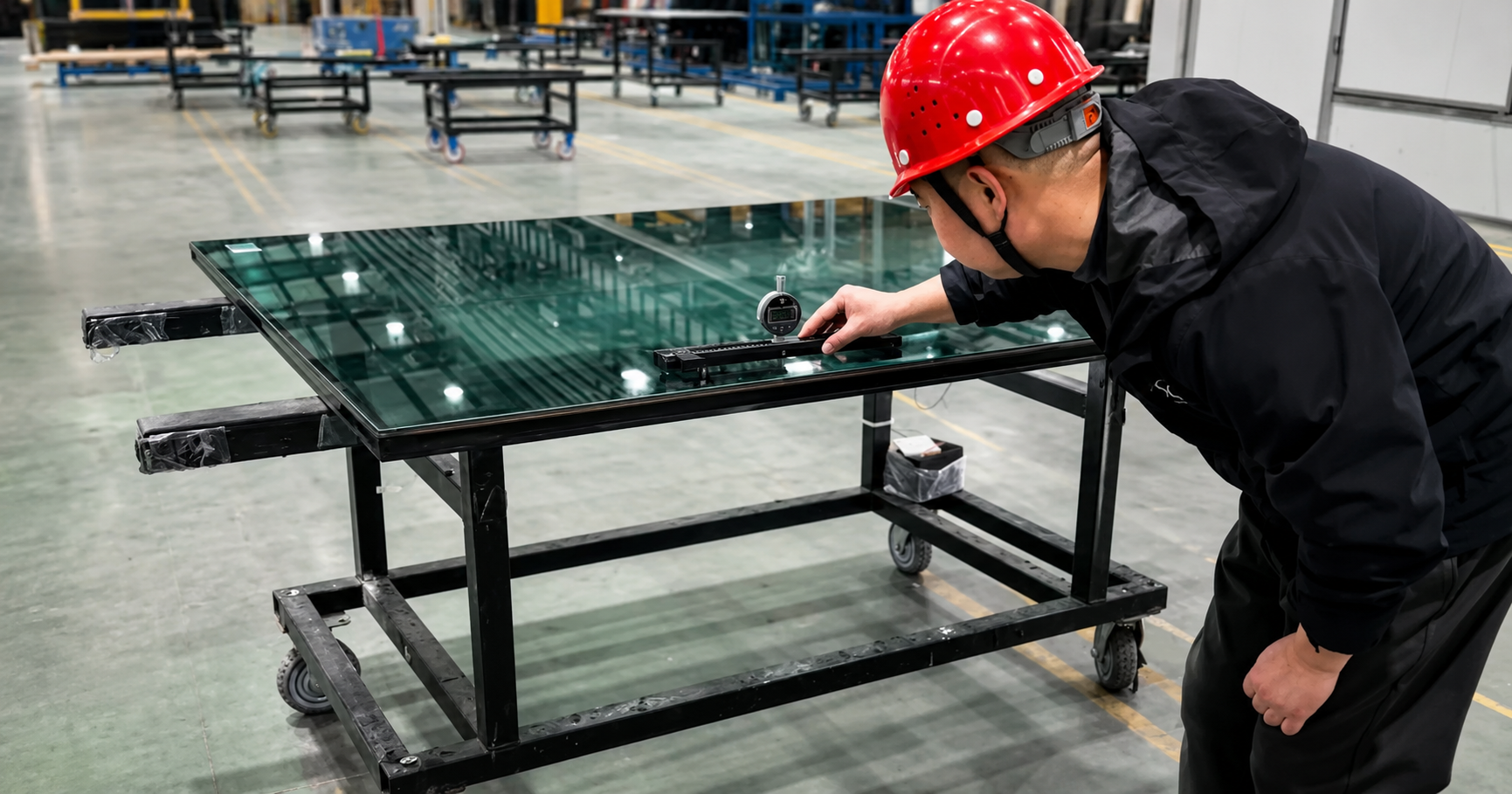
Roller wave distortion is measured across the panel surface to verify that optical distortion remains within acceptable tolerance levels for façade applications.
ASG also performs surface stress testing to confirm that the tempering process has achieved the required compression levels and complies with project performance requirements.
QC Evidence
 Roller wave verification across centre and edge zones
 Surface compression verification after tempering
Why This Matters
By combining dimensional inspection, optical quality verification and stress testing, ASG helps ensure that heat-treated glass achieves both structural reliability and consistent façade appearance before progressing to assembly and installation.
If you would like to discuss heat-treated glass requirements for your upcoming project, feel free to contact the ASG team.
Share:
Curved, Laminated and Oversized Glass: Engineering Constraints and Solutions
Newcastle Airport Expansion: Delivering High-Performance Glazing for Australia's Newest International Gateway